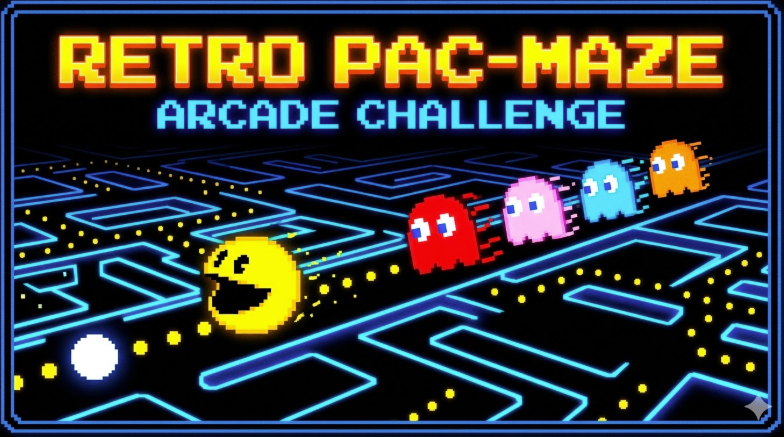
What Is Pacman?
Pacman is a legendary arcade game developed by Namco and released in 1980. Created by game designer Toru Iwatani, this iconic maze-chase game has become one of the most recognizable and influential video games in history. The game features a bright yellow circular character with a wedge-shaped mouth who navigates a maze, eating dots while being chased by colorful ghosts.
The genius of Pacman lies in its perfect balance of simplicity and depth. While the basic concept - eat dots, avoid ghosts - could not be simpler, the game offers endless strategic possibilities. Each ghost has its own unique personality and hunting pattern, the maze layout creates tense chokepoints, and the power pellet mechanic turns the tables in the most satisfying way possible.
The History of Pacman
Origins in Japan
Pacman was originally called “Puck Man” in Japan, named after the Japanese onomatopoeia “paku paku” describing the sound of eating. When the game was released in North America, the name was changed to Pacman to prevent potential vandalism of arcade cabinets (changing “P” to “F”).
Creator Toru Iwatani wanted to create a game that would appeal to women as well as men, moving away from the violent shooter games that dominated arcades at the time. He drew inspiration from food - specifically a pizza with a slice missing, which gave him the idea for Pacman’s distinctive shape.
Global Phenomenon
Released in Japan in May 1980 and in North America in October of the same year, Pacman became an unprecedented success. By the early 1980s:
- Over 400,000 arcade cabinets were sold worldwide
- The game generated over $1 billion in revenue within a decade
- Pacman became the first video game character to appear on the cover of Time magazine
- Merchandise including cereals, toys, and clothing generated additional billions
- A Saturday morning cartoon series aired from 1982 to 1983
Cultural Impact
Pacman transcended gaming to become a cultural icon. The character’s simple, friendly design made him instantly recognizable worldwide. The game’s influence can be seen in countless maze-chase games that followed, and its ghosts remain some of gaming’s most memorable antagonists.
How To Play Pacman
Basic Controls
- Use arrow keys to move Pacman up, down, left, or right through the maze
- Eat all dots (pac-dots) to clear the level
- Avoid the four ghosts - contact costs a life
- Eat power pellets (large flashing dots) to turn ghosts blue and vulnerable
- Eat fruits that appear in the center for bonus points
Understanding the Ghosts
Each of the four ghosts in Pacman has its own distinct personality and hunting strategy:
Blinky (Red) - The Chaser Blinky directly targets Pacman’s current position. As you clear more dots, Blinky speeds up, making him increasingly dangerous in the late stages of each level.
Pinky (Pink) - The Ambusher Pinky tries to position himself four spaces ahead of where Pacman is heading. This makes him particularly dangerous when you’re moving in straight lines.
Inky (Cyan) - The unpredictable Inky’s behavior is based on a combination of Blinky’s position and Pacman’s position, making him the most erratic and difficult ghost to predict.
Clyde (Orange) - The Feigned Ignorance Clyde appears to chase Pacman but retreats when he gets too close, often seeming to ignore Pacman entirely. Don’t be fooled - this can lead you into traps.
Game Mechanics
The Maze The Pacman maze is filled with:
- 240 regular dots worth 10 points each
- 4 power pellets worth 50 points each, located in the corners
- Tunnels on the sides that warp Pacman to the opposite side
- The ghost house in the center where ghosts regenerate
Power Pellets When Pacman eats a power pellet:
- All ghosts turn blue and flee
- Ghosts can be eaten for bonus points (200, 400, 800, 1600)
- The effect lasts shorter each successive level
- Eating multiple ghosts in one power pellet sequence multiplies the score
Bonus Fruits A fruit appears in the center tunnel after eating 70 dots, and again after 170 dots. Fruits progress in value:
- Cherry: 100 points
- Strawberry: 300 points
- Orange: 500 points
- Apple: 700 points
- And more in higher levels
Advanced Pacman Strategies
Beginner Tips
- Learn the maze layout - Knowing where tunnels and escape routes are is crucial
- Don’t rush - You have plenty of time; rushing leads to mistakes
- Use the tunnels - The side tunnels are great escape routes since ghosts slow down in them
- Save power pellets - Don’t eat them immediately; save them for emergencies
Intermediate Techniques
- Ghost grouping - Try to keep ghosts grouped together so you can eat multiple when powered up
- Pattern recognition - Learn predictable ghost movements to navigate tight situations
- Fruit timing - Plan routes to collect bonus fruits without taking unnecessary risks
- Corner cutting - Ghosts can’t turn as quickly as Pacman; use this to your advantage
Advanced Play
- Target priority - Clear isolated dot clusters first to minimize backtracking
- Ghost manipulation - Lead ghosts away from areas you need to clear
- Split-second decisions - Learn when to commit to paths and when to retreat
- High-score optimization - Maximize ghost chains and never miss bonus fruits
The Infamous Level 256
Dedicated Pacman players know about the legendary “split-screen level.” Due to a bug in the original arcade hardware, level 256 causes the right side of the screen to display random symbols and garbled graphics, making the level impossible to complete normally.
This “kill screen” has become legendary in gaming culture. The maximum possible score in Pacman is 3,333,360 points, achieved by eating every dot, power pellet, fruit, and ghost possible on the first 255 levels. Only a handful of players have ever achieved a perfect score.
Pacman Records and Competitions
High Scores
The world record for Pacman has changed hands many times over the decades. Billy Mitchell famously claimed the first perfect game in 1999, though this was later disputed. In 2021, David Race achieved a verified perfect score of 3,333,360 points.
Competitive Play
Pacman remains popular in competitive gaming, with tournaments held at events like the Classic Gaming Expo. The game demands incredible endurance - a perfect game takes approximately 4-6 hours of continuous play.
Games Like Pacman
If you enjoy Pacman, try these similar games:
- Ms. Pacman - An even better version with more maze variety
- Jr. Pacman - Features vertical scrolling and new gameplay elements
- Lock ‘n’ Chase - A Pacman clone with door mechanics
- Mouse Trap - Similar maze gameplay with different mechanics
- Crystal Castles - 3D maze navigation with similar dot-collection
Frequently Asked Questions
Who created Pacman? Toru Iwatani, a game designer at Namco, created Pacman in 1980.
Why is it called Pacman? Originally “Puck Man” in Japan (from “paku paku” - the sound of eating), changed to Pacman for international release.
What are the ghosts’ names? Blinky (red), Pinky (pink), Inky (cyan), and Clyde (orange). In the original Japanese version, they were named differently.
Can you beat Pacman? Level 256 is the “kill screen” that makes the game impossible to complete normally. The maximum achievable score is 3,333,360 points.
Is Pacman still popular? Absolutely! Pacman remains one of the most played and recognized games worldwide, with new versions released regularly.
Play Pacman Online Now
Experience gaming history by playing Pacman online right here! No downloads, no quarters needed - just pure arcade nostalgia in your browser. Whether you’re reliving childhood memories or discovering this classic for the first time, Pacman offers timeless entertainment that never gets old.
How high can you score? Can you clear all 255 levels? There’s only one way to find out. Good luck, and happy munching!